Organic food had 82% fewer pesticide residues in two datasets
Should you eat organic food or not? @bryan_johnson said that sometimes organic is worse than non-organic, so I wanted to check this myself. I found 2 datasets: - 🇺🇸 California DPR: 330 organic + 2,743 non-organic samples - 🇩🇪 EFSA Germany: 1,913 organic + 7,907 non-organic samples I compared measured pesticide concentrations, detection frequency, multiple residues, and EPA-relative exposure. 1. Pesticide residues appeared in 13.9% organic vs 75.2% non-organic, about 82% less often. 2. Organic had lower EPA-relative exposure for 22 of 23 foods. I plotted the chart below that shows organic foods in color and their non-organic equivalents in gray for comparison: pesticide-guide.vercel.app What I understand from this data: 1) If you can, go full organic. 2) If not, prioritize organic for 🥬 lettuce (5% vs 80% detected), 🍎 apples (5% vs 91%), 🫑 peppers (16% vs 80%), 🍐 pears (22% vs 89%), and 🥬 spinach (31% vs 95%). 3) Broccoli 🥦 is a lower priority: exposure was only 0.014% vs 0.022% of the EPA reference level
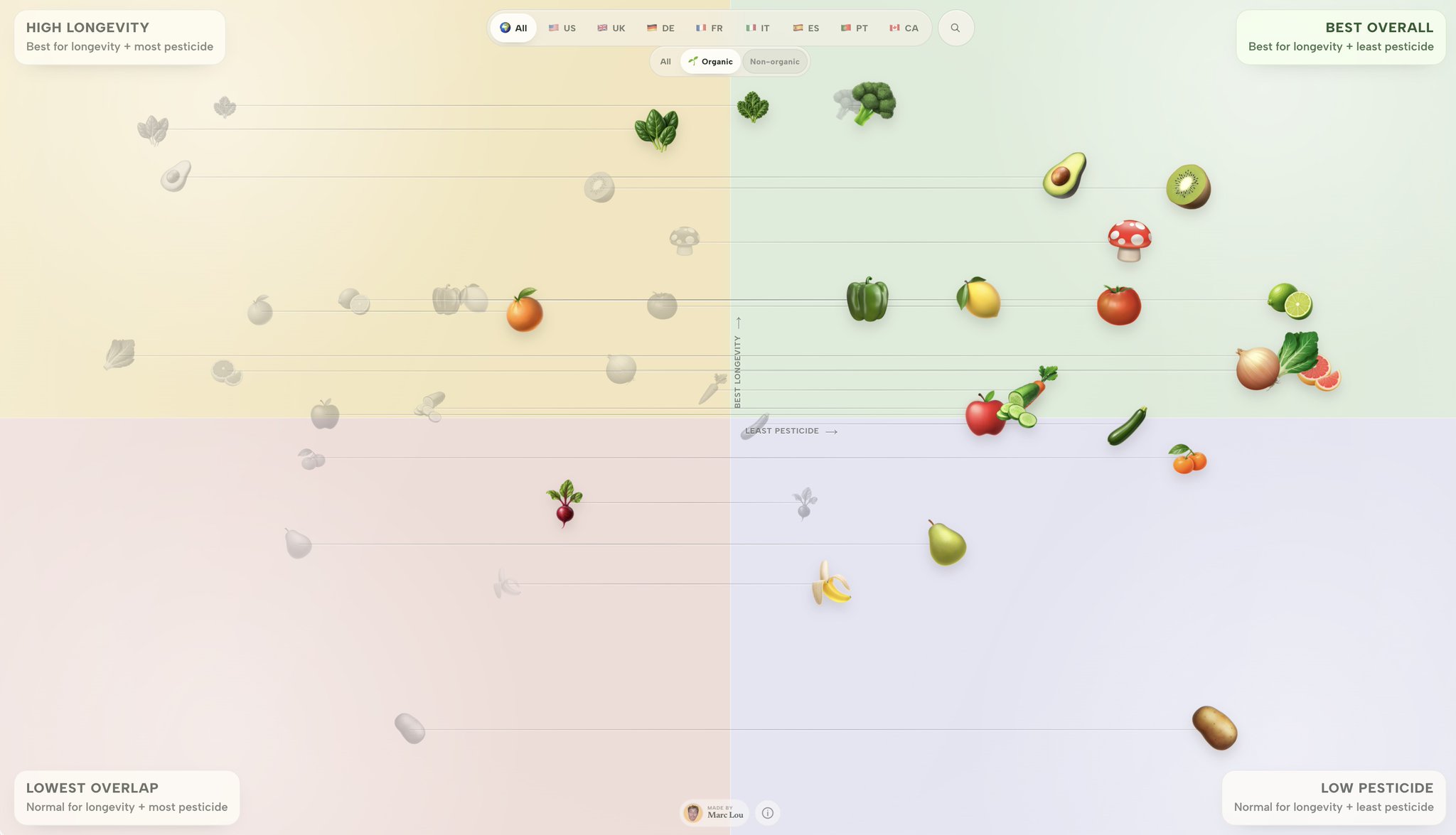
 Marc Lou@marclou · Aug 19, 2026I made a mini-app that compares pesticide and longevity for 69 fruits, vegetables, and beans.
It uses 124,880 USDA + UK samples, EPA toxicity benchmarks, and Food Compass 2.0. Click a fruit to see more.
pesticide-guide.vercel.app
Take #1: The healthiest fruits/veggies have the most pesticides. Fuck.
Take #2: Beans are superfoods.
Marc Lou@marclou · Aug 19, 2026I made a mini-app that compares pesticide and longevity for 69 fruits, vegetables, and beans.
It uses 124,880 USDA + UK samples, EPA toxicity benchmarks, and Food Compass 2.0. Click a fruit to see more.
pesticide-guide.vercel.app
Take #1: The healthiest fruits/veggies have the most pesticides. Fuck.
Take #2: Beans are superfoods.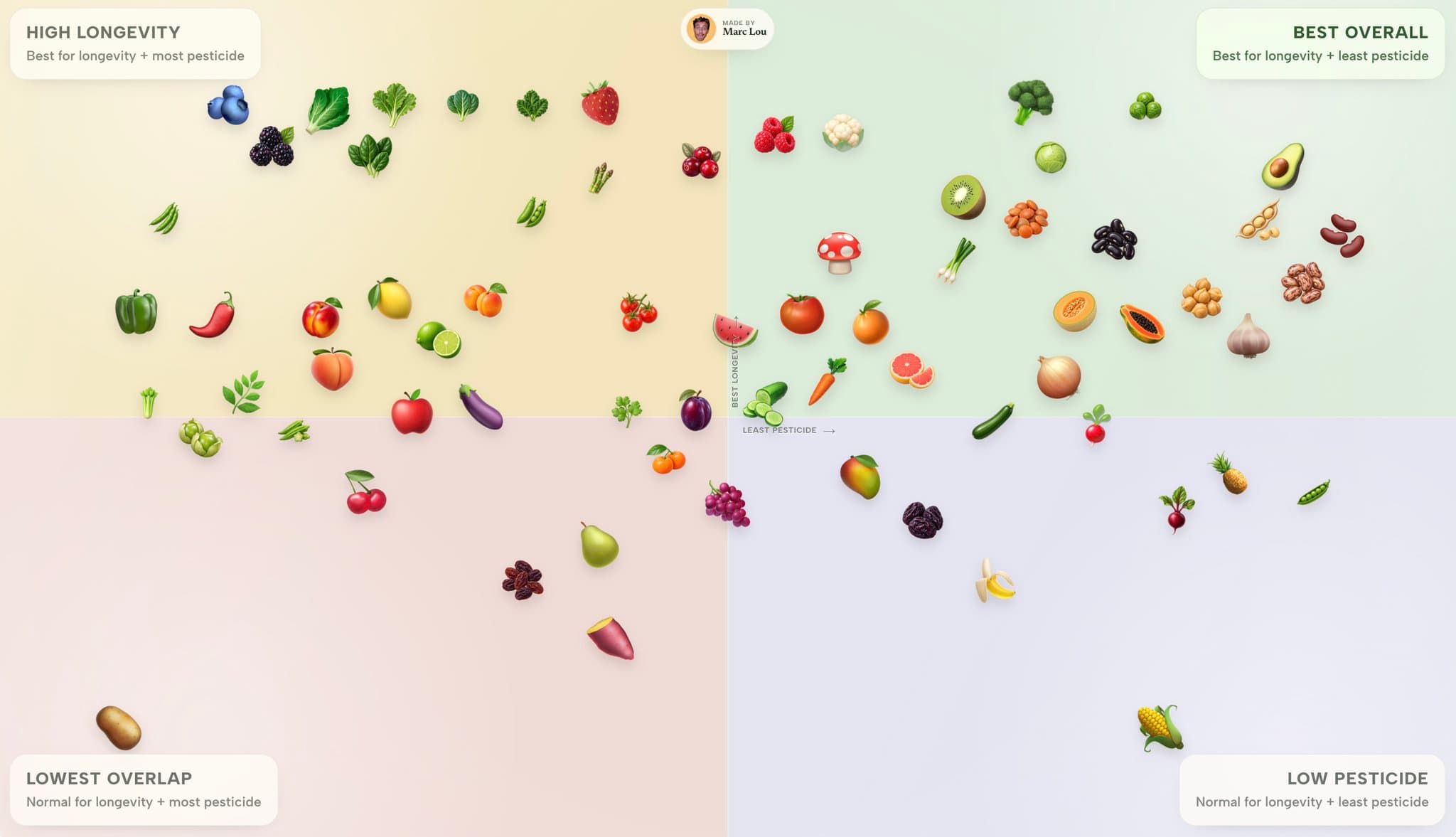

@marclou · Aug 21, 2026
@bryan_johnson the man was right
 Ole Lehmann@itsolelehmann · Aug 19, 2026If you buy organic inside the EU you are fine
Bryan Johnson’s comments to pesticides in organic do not hold up for the EU
Ole Lehmann@itsolelehmann · Aug 19, 2026If you buy organic inside the EU you are fine
Bryan Johnson’s comments to pesticides in organic do not hold up for the EU- 3 replies
- 21 likes
- 7.3K views